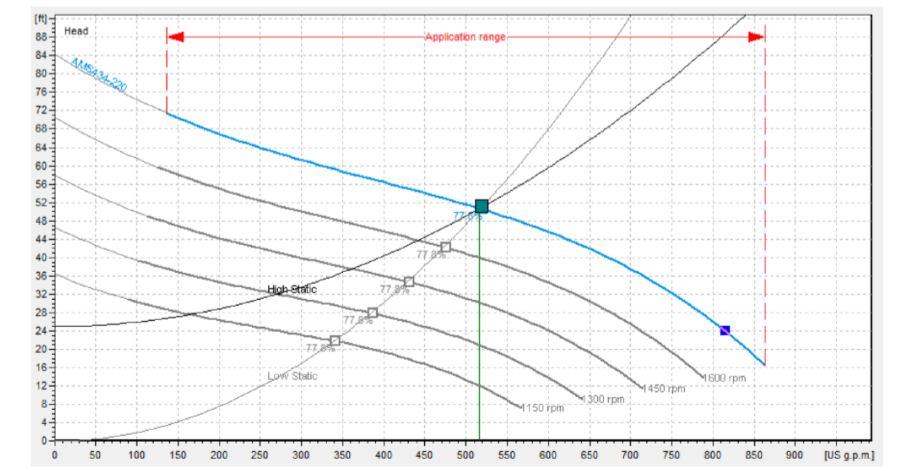
Choosing the right pump for a lift station is much easier when you know how to read a pump curve. This chart shows how a pump performs under different flow and head conditions. Once you understand the basics, pump curves become one of the best tools for selecting the right equipment.
What Is a Pump Curve?
A pump curve is a graph that shows the relationship between:
- Flow (GPM) – how much water the pump can move
- Head (TDH) – how much pressure the pump can overcome
- Efficiency – how well the pump uses energy
This information helps you match a pump to your system’s needs.
Main Parts of a Pump Curve
- Flow (GPM) – Bottom of the graph
The horizontal line shows how many gallons per minute the pump can push.
- Head (TDH) – Side of the graph
The vertical line shows the total pressure or resistance the pump must overcome.
- Performance Curve
The main sloped line shows what flow and head the pump can achieve at the same time.
- Best Efficiency Point (BEP)
This is the “sweet spot” where the pump runs the best—high efficiency, less wear, and longer life.
- Impeller Lines
Some curves show different impeller sizes. Bigger impellers give more head and flow; smaller ones give less.
How to Use a Pump Curve
Step 1: Know Your TDH
Calculate your system’s total dynamic head, including:
- Vertical lift
- Pipe friction
- Length of force main
- Fittings and valves
Step 2: Know Your Required Flow
Most lift stations have a target GPM based on peak usage.
Step 3: Plot Your Point
Find where your TDH and GPM meet on the curve.
- If the point is on the curve, the pump can work.
- If it’s far from the BEP, the pump may not run efficiently.
Step 4: Check Horsepower
Make sure the pump’s motor size matches what your system needs.
Why Pump Curves Matter
Reading a pump curve helps you:
- Pick the right pump the first time
- Avoid oversizing or undersizing
- Save on energy costs
- Reduce maintenance
- Improve pump life and reliability
Understanding pump curves makes pump selection simpler, faster, and more accurate. If you ever need help reading a curve or choosing the right pump, Triple D Pump is always here to help.